Leave the Next Student Editor a Newsroom They Can Run
Start with the next editor’s first assignment
A newsroom handover succeeds when the incoming editor can complete a real task without repeatedly calling the person who graduated. Begin with that task, not with a promise to document everything. Ask the new editor to take one ordinary story from assignment to publication and note where missing knowledge stops the process.
Imagine a student paper preparing for its spring transition. The outgoing editor has a crowded drive, an active reporting calendar and a collection of habits nobody has written down. A useful handover does not require describing every file. It requires identifying the decisions the new team will face first and making the relevant information easy to find.
Build a short operating map
Create one page showing who assigns stories, who checks them, who approves publication and who handles corrections after publication. Use roles as well as names so the document remains understandable when people change. Include the point where the adviser or another appropriate support person can be consulted without confusing support with authorship or routine editorial responsibility.
The National Scholastic Press Association’s resource hub includes planning tools, staff-manual topics and editorial resources for student media. These provide useful prompts for identifying what a newsroom needs to explain. A local handover still has to describe the publication’s actual process rather than importing a generic manual unchanged. [1]
Pass on decisions, not just documents
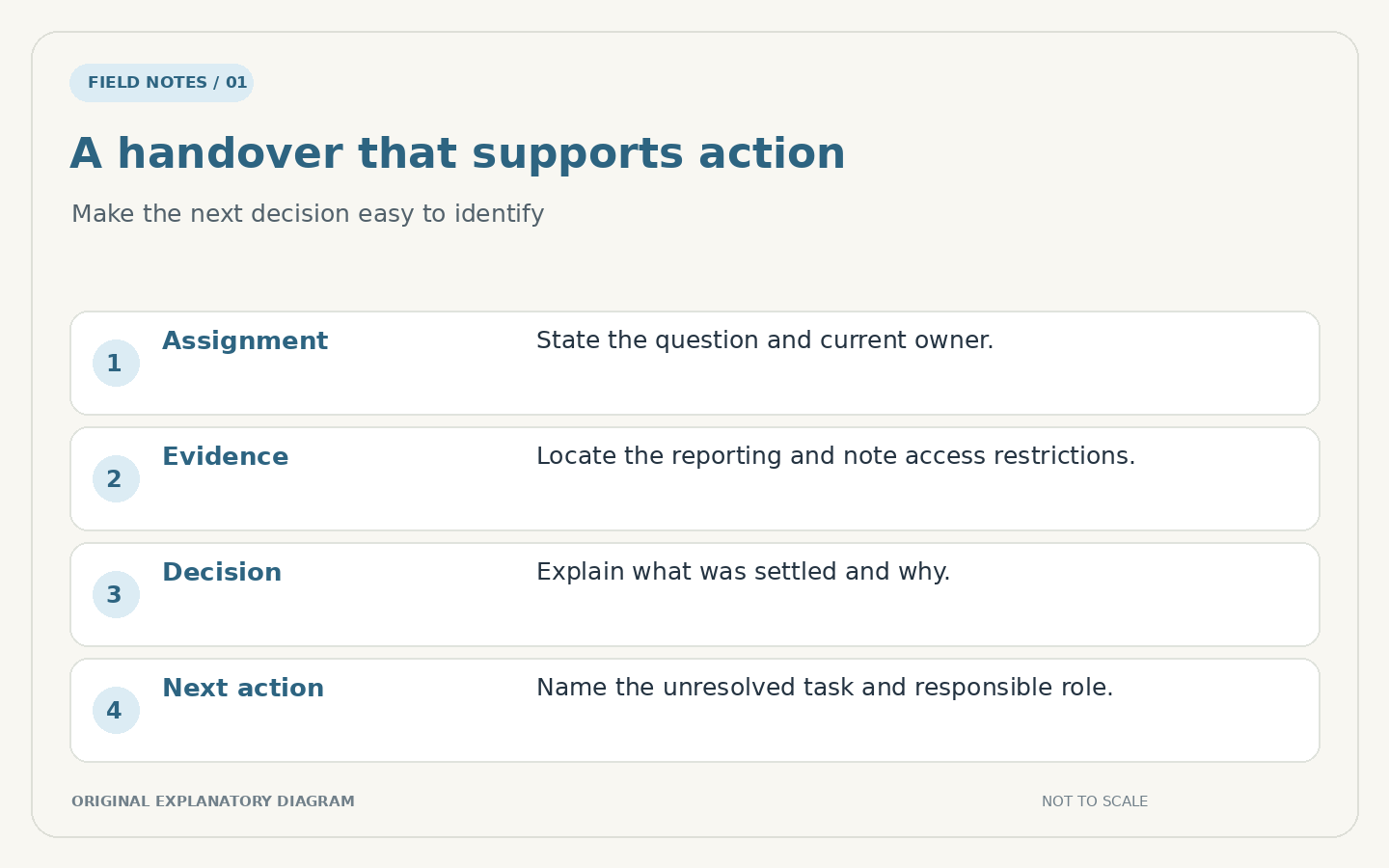
For each continuing project, record what has been decided, why it was decided and what remains open. A folder of interview notes may tell the new editor what a source said but not why the story was paused. The missing decision can be more important than another copy of the draft.
For example, a campus dining investigation might be waiting for a response about weekend opening hours. The handover should name that unresolved question, the last contact date and the next reasonable action. It should not merely label the story almost finished. That phrase can lead a new editor to publish before the missing response or verification has been addressed.
Keep the source trail usable
Choose one completed story and make it a worked example. Show where the assignment, interview material, verified facts, edited copy and published version belong. Explain any restrictions on access to source information. A newcomer should be able to see how a claim in the article connects to the material that supports it.
Keep sensitive records separate from broadly shared planning documents. The whole staff may need to know that an interview is complete without needing a source’s private contact details or unused personal disclosures. This is an editorial design choice: share enough information to coordinate the work while giving responsibility for sensitive material to the people who actually need it.
Make correction ownership explicit
The Society of Professional Journalists’ ethics code calls for accountability, transparency and prompt correction of errors. A staff transition should preserve that responsibility after the original reporter or editor leaves. Readers should not have to discover the publication’s graduation calendar before finding someone who can address a factual concern. [2]
Write down how a correction request reaches the newsroom, who reviews the underlying evidence and how the decision is recorded. Include an example that distinguishes a factual correction from a disagreement with a fair description. If a question remains unresolved at handover, identify it openly so the new team does not mistake silence for a completed review.
Rehearse a difficult but ordinary scenario
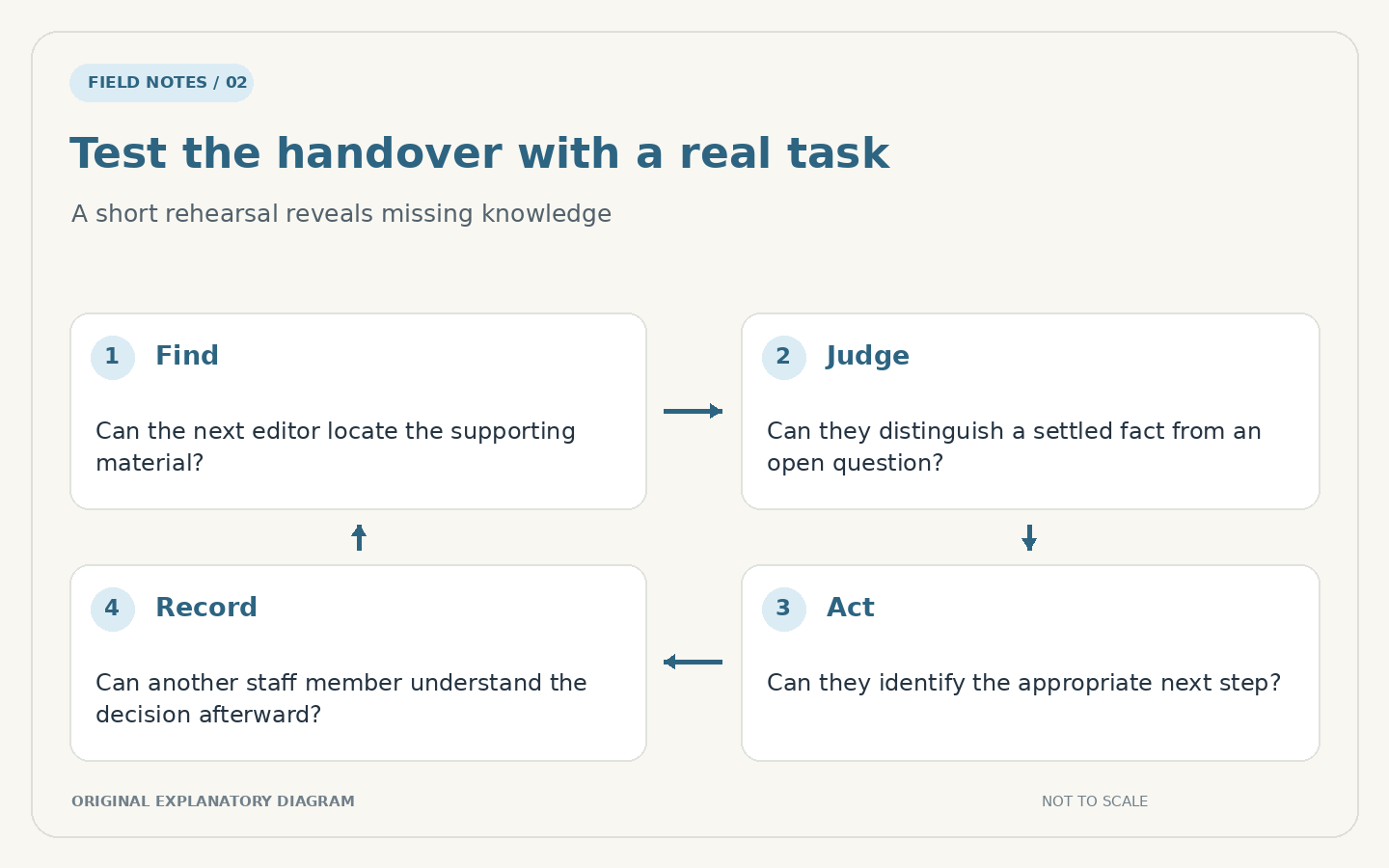
Give the incoming team a fictional situation: a source says the published story has the wrong opening time, while the reporter’s notes and the institution’s website disagree. Ask the team to locate the evidence, decide whom to contact and draft a clear update if one is warranted. The exercise reveals gaps in the process without exposing an actual source.
Watch for hidden assumptions. Perhaps only one outgoing editor knows where archived pages are stored, or only one person receives messages from readers. Fix those bottlenecks before the transition. The aim is not to test whether the new editor has memorised the old editor’s habits; it is to make the newsroom less dependent on any one individual.
Preserve the unfinished questions
An abandoned idea can still contain useful reporting. Record what was learned, why the project stopped and what would be needed to restart it. Distinguish a weak premise from a strong question that simply lacked time. Otherwise, successive staffs may repeat the same preliminary interviews without ever reaching the issue that deserves further work.
For the dining story, a note might explain that the original question about menu variety led to a more concrete question about access during evening classes. The next team can assess that question afresh. It should not inherit a predetermined conclusion, a promise made to a source that it cannot honour or an instruction to publish merely because work has already been invested.
Label the status of each unfinished project in plain language: ready for a new assignment decision, waiting for a named response, or closed with an explanation. This prevents the next staff from treating every old folder as an obligation. It also gives them a fair basis for choosing which questions still deserve their limited reporting time.
Make the first week realistic
Give the incoming staff a short priority list with a clear owner for each item. Include routine publication tasks and one opportunity to improve the process. Avoid handing over a backlog so large that the new team feels required to complete every old idea before exercising its own judgment.
Agree on a limited period when the outgoing editor can answer practical questions, if they are willing. The new editor should still be able to make decisions independently. A healthy handover transfers responsibility instead of creating an invisible senior editor who continues directing the publication through private messages long after leaving the formal role.
Finish with a usability check
Ask the incoming editor to find an unfinished assignment, identify the next action and explain how a correction would be handled. If they can do that, the core handover is working. If not, revise the map and examples before adding more pages. A short usable guide is more valuable than a comprehensive document whose essential steps remain obscure.
The best record of an outgoing staff is not a system that only that staff could operate. It is a publication that can keep reporting, questioning and improving after its members move on. Passing on the reasons behind decisions, the location of evidence and the responsibility for readers gives the next team something stronger than a folder: it gives them a workable starting point.
Sources
- Info Hub: NSPA Resources — National Scholastic Press Association
- SPJ’s Code of Ethics — Society of Professional Journalists